
Introduction

|
| Former IFSU: red-brick building, 2nd floor (at the old Amamiya campus) |
AiCephLab
This is where research is conducted on various aspects of the life of cephalopod molluscs (particularly octopuses, but also squids). Marine biologist Ian Gleadall is the leader of this research, which involves a number of other individuals (who are introduced here and here). The main emphasis at present is on the Octopus Aquaculture Development Project. Other research themes are listed here.
AiCephLab* is the research core of what was IFSU, the International Fisheries Science Unit (established in March, 2010, as a new unit in the Graduate School of Agricultural Science). IFSU was originally the only section of the Applied Aquatic Bio-Science Subdivision to function entirely in English, as opposed to native Japanese, and was one aspect of this university's efforts to present a more accessible international presence. That particular function is now under the auspices of the Trans-Faculty Erudition Unit. AiCeph LLC is a research and education consultancy.
*AiCephLab is a Japanese & English contraction meaning a laboratory where research is done by people who like cephalopods.
What is the Octopus Aquaculture Development Project?
The official project title in Japanese translates into English as: ‘Local Business Creation Through Applied Development of Octopus sinensis Complete Aquaculture and Associated Hi-Tech Food Products’.
This project has two main aims:
(1) to successfully culture the Asian common octopus, O. sinensis; and
(2) to help revive the local economy by providing new business opportunities through commercially-viable land-based aquaculture and related developments in new food products derived from octopus.
The project is now at the second stage of a two-stage 7-year kick-off programme of funding by the Japan Science and Technology Agency (JST). It was born out of the need to revive the economy of northeastern Japan following the earthquake and tsunami disasters of 2011. Even before these disasters, the local economy was depressed because of two major demographic factors: the declining population generally, and local decline caused by migration to major cities, particularly Tokyo.
Research base
As the name suggests, the research conducted here has a strong emphasis on aquaculture, particularly concerning octopuses. However, as in the wild, octopuses cannot survive without the other organisms in their ecosystem, and this is true also for aquaculture. Therefore, research in this unit involves a number of other animals and plants, each of which have key functions in facilitating our investigations of the biology, feeding and reproduction of octopuses.
Why aquaculture?
The consumption of fish takes place through two main types of commercial activity: fishing and aquaculture. Aquaculture is a booming industry that is necessary both to supply the rising human population with a source of dietary protein, essential vitamins and oils, and to remove pressure on the dwindling populations of wild fish taken through conventional fishing activity.
In 2012, fish produced by aquaculture world-wide surpassed 50% of all fish consumed (ref.), and the aquaculture industry now employs more than 23,000,000 people (ref).
In view of recent interest in octopus as a good source of protein in the human diet, commercially viable aquaculture techniques are urgently needed to meet the rising demand and to ensure a sustainable supply of octopus in the future.
Why octopuses?
With their relatives (the squids, cuttlefishes and nautiluses), octopuses belong to the Class Cephalopoda, which is the most advanced animal group among the molluscs. Octopus and squid are found throughout the World Ocean and have long been in competition with fin-fish. As with their competitors, octopus and squid are harvested intensively by fishermen around the world.
|
|
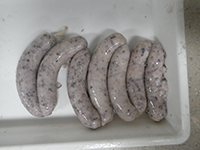
Hand-made octopus sausages - for experimental use only - not for human consumption ! |
The octopuses regarded as the tastiest (and therefore the most valuable) belong to a group of closely-related species known as the Octopus vulgaris group, which in Japan is represented by Octopus sinensis ('madako' in Japanese). Octopus meat is lean (low in fats and carbohydrates) and without bones or gristle. It is high in protein and other nutrients such as taurine, an amino-acid identified as particularly healthy for humans (ref.).
Octopuses have become well known recently for their intelligence and unusual genetic make-up (ref.), which help them compete with fin-fish. In the last few decades, humans have removed too many fin-fish from the oceans and squid have been able to take the place of some of them. Octopus and squid seem very well adapted to survive heavy fishing, because they have a short life cycle (typically 6 months to just over a year): many fin-fish species need several years to reach maturity, which makes their recovery from overfishing very slow, or even impossible. However, overfishing by humans threatens even squid and octopus.
As with other key groups of farmed marine animals, the period just after hatching is one of the most vulnerable stages in the life cycle. Like tuna and eels, the common octopuses have a planktonic post-hatching stage which lasts a little over a month in the wild. This is a period of very high mortality and is one of the most significant barriers to commercial aquaculture. A current major objective of the research carried out here at AiCephLab is to devise reliable methods to culture octopus through this vulnerable period with a high survival rate.
Research themes
Much of the research at AiCephLab is focussed on what is required to develop successful aquaculture of Octopus sinensis. However, other research also is in progress. The following points summarize the main research themes.
- Technical and ecological aspects of farming Octopus sinensis by land-based aquaculture
- Life-cycle and spawning control of small species of shore crab, particularly Hemigrapsus spp., as feed organisms for paralarval & juvenile octopus
- Investigation of beach amphipod and isopod populations as feed organisms for juvenile octopus
- Taxonomy, systematics and fisheries of octopuses and Japanese loliginid squids
- Life cycle, nutrition and development of the pygmy squid, Idiosepius
(Research themes 4 and 5 are AiCephLab research activities funded from sources other than JST).
Publications
Some of the publications from this unit can be found here.
Contact information
| Address: | Graduate School of Agricultural Science Tohoku University, Aobayama Campus Aoba 468-1, Aramaki Sendai Japan 980-0845 |
| Office Phone no.: | +81-(0)90-2987-7222 |
| email: | |
| Location on Campus (Main Building): |
Hatchery: Room W213 Wet Lab.: Room W201 Crab Lab.: Room N107 |
| Organization parent structure: | Graduate School of Agricultural Science, Trans-Faculty Erudition Unit |

|
| Graduate School of Agricultural Science Main Building (Aobayama Campus) |
Glossary of terms used on the AiCephLab web pages
- ad libitum
- freely (in the sense of providing enough feed for animals to eat as much as they want, whenever they want)
- Class
- major taxonomic rank (e.g. Class Bivalvia, the 2-shelled molluscs; Class Cephalopoda, the squids, octopuses and nautiluses)
- DHA
- docosahexaenoic acid, a PUFA of benefit to health
- EPA
- eicosapentaenoic acid, a PUFA known to be of high nutritive value in many organisms, including octopuses and humans
- larva
- (pl. larvae) an early life stage that is different from the adult in morphology and behaviour (usually living as part of the plankton), separated from other stages by abrupt changes in morphology (e.g. crab larvae, fish larvae)
- myopsid
- ‘closed-eyed’ squid, which have a cornea covering the eye except for a small pore communicating with the surrounding seawater (compare with oegopsid)
- mysis
- one of the larval stages of shrimps
- megalopa
- one of the larval stages of crabs
- monoculture
- the rearing of large numbers of just a single species of animal or plant (compare with polyculture)
- ocellus
- (pl. ocelli) a false eye spot on the skin of the arms of some octopuses - used as part of a deimatic or startle response
- oegopsid
- ‘open-eyed’ squid, which have no corneal covering separating the eye from the surrounding seawater (compare with myopsid)
- on-growing
- the final stage of aquaculture, feeding adult animals to make them grow as large and as quickly as possible, ready for harvesting
- Order
- taxonomic rank; a group of several families
- paralarva
- (pl. paralarvae) like a larva (living as part of the plankton for several weeks) but without any abrupt change in development to reach the adult stage. Paralarvae are typical of many species of Cephalopoda
- Phylum
- taxonomic rank denoting a major type of body form (e.g. Phylum Mollusca, the soft-bodied, non-segmented animals; Phylum Arthropoda, the jointed-legged animals)
- pl.
- plural
- polyculture
- the rearing of several different groups of organisms together, so each benefits and several different crops can be harvested from the same culture system (compare with monoculture).
- predator
- an animal that eats other animals
- prey
- an animal eaten by another animal
- protein skimmer
- a device that removes organic matter, particularly proteins, from water by creating foam inside a tower. The foam rises and spills out at the top of the tower, carrying away the unwanted organic matter and so removing a source of nutrients that could support pathogenic bacteria
- PUFAs
- polyunsaturated fatty acids. These are fatty acids containing more than one double bond. They are lighter than saturated fatty acids (which have no double bonds, because all carbon atoms in the fatty acid chain have a maximum number of hydrogen atoms attached). Lighter means they dissolve more easily in the blood, so PUFAs are better for health. Octopus paralarvae need large amounts of PUFAs for correct development of their large and sophisticated nervous system. Examples of PUFAs include DHA and EPA (ref.)
- surume
- dried squid
- zoea
- (pl. zoeae) early larval stage of crabs and shrimps. A typical character of a zoea is the presence of a long, curved spine on its back (see an example here)

