
The Hatchery . . . Facility for hatching octopus eggs
Introduction
The hatching facility* is situated in one corner of the Fisheries Research Lab. (Room W213). In the past, the aquarium of this system (Aquarium A) has been used also for mating experiments, but at present it is used only as a holding facility for a single brooding female Octopus sinensis inside a commercial octopus pot, complete with her eggs. As the paralarvae hatch, they are removed and taken to the Wet Lab. for feeding experiments.
*[The Hatchery (along with the Crab Lab.) began as part of Lab. 1 at Amamiya (the former campus) and was moved to new facilities at Aobayama campus in February, 2017].
Laboratory Environment
To prevent condensation problems, the lab. room temperature is kept below that in the aquarium and sump, which are covered with lids to minimize evaporative loss. The lab. containing the hatching facility is maintained at around 20°C. The presence of 3 powerful pumps (one serving the main water circulation and two driving the recirculating protein skimmer) heats the circulating water, which unchecked can reach about 10°C above room temperature. Therefore, a cooler is indispensable: a separate loop from the sump feeds the cooler unit, which is set to maintain a temperature around 21°C.
Aeration
A single AP-80 air pump (Yasunaga, Tokyo) provides all the aeration in the lab. (80 litres per minute at full capacity), transferred through a system of VP 13 PVC pipes with stainless steel taps screwed into holes drilled at intervals and sealed with Esron PVC glue (Sekisui Chemical Engineering, Tokyo). The air intake filter is cleaned every 3 months or so.
A bleeder outflow pipe is included to avoid excessive pressure within the system and as a safeguard against water sucking back to the pump in the event of a power failure. This bleeder pipe has its own cock for pressure adjustment and is plugged with a piece of filter material as a sound baffle.
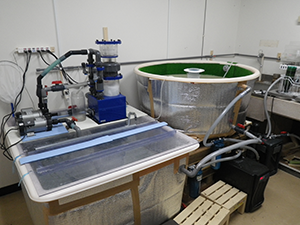
|
| Hatchery system |
Hatching Facility Specifications
| System capacity: | around 990 litres |
| Aquarium: | cylindrical, around 350 litres |
| Sump: | near-rectangular (120 x 100 x 80 cm) |
| Sump capacity: | 600 litres, with 2 sock filters, a protein skimmer and 4 air-lifts |
| Main circulation: | Rei-Sea RMD-551 (60-70 litres. min-1) |
| Protein skimmer: | MRC Recirculating Protein Skimmer, model MR-2R |
| Skimmer feeder pump: | Rei-Sea RMD-551 pump |
| Skimmer recirculation pump: | Rei-Sea RMD 701 pump (86-97 litres. min-1) |
| UV sterilizer: | Iwaki UVF-1000 |
| Heater: | (not required, due to heat exchange from the 3 pumps) |
| Cooler: | Zensui ZR-130E |
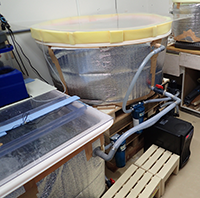
|
| Aquarium A with lid in place |
Aquarium Construction
The aquarium (Aquarium A) is raised on a sturdy wooden platform so that it lies above the level of the sump, resting on non-slip matting and anchored in place with wooden blocks nailed to the platform, to prevent lateral slipping in the event of an earthquake. The cooler is free-standing on the floor. The filters and UV sterilizer are mounted on the aquarium platform.
Both the aquarium and sump are insulated to minimize the escape of heat to the surrounding atmosphere of the (cooler) room, with the aim of maintaining a stable temperature. The thermostat of the cooler unit oscillates around 0.6°C once every 8 hr, so there are 3 temperature cycles per day.
All electrical connections pass through safety circuit breakers at the mains sockets. All seawater is artificial, made using deionized tapwater and Instant Ocean synthetic sea salt supplemented with 90 µmol. l.-1 Strontium chloride (ref.). The in-line water filters are all wound polypropylene fibre, 5 µm (AsOne FPP-05-1), mounted in an Organo Model III 250 mm housing.
The in-line system includes two filters, one inserted immediately downstream of the UV sterilizer as a precaution to remove any activated particulate matter leaving the sterilizer. In particular, (i) an anecdotal account has suggested that aquarium animals are irritated by water that has passed through a UV sterilizer; and (ii) it is known that certain water-borne organics can be rendered more toxic after passing through a UV sterilizer (ref.).
Water Circuit
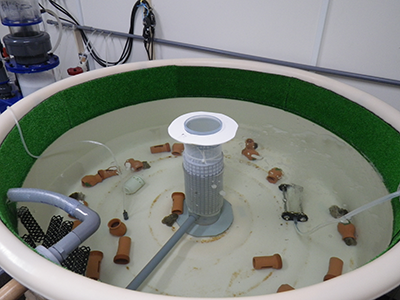
|
| Hatchery Aquarium (small earthenware dens previously housed smaller species of octopus) |
The main pump (located on a block between the sump and the platform supporting the aquarium) lifts water from the sump through a filter, a cooler, a UV sterilizer and a final pre-aquarium filter. The protein skimmer is mounted over the sump. All connections are with PVC pipe of size VP 20.
Water flows into the aquarium near the top and is directed down along the inner wall to disperse the strength of the inflow current. A precautionary overflow pipe leads to the adjacent sink.
The return from the aquarium drains from inside a central cylindrical transparent PVC column with several large holes near the base. It is covered with a snugly-fitting cylindrical piece of netting held clear of the drain holes by a supporting plastic frame and secured with plastic cable ties.
A closely-fitting flange of white PVC sheeting at the top prevents octopuses from climbing up and into the open column.
The water level in the aquarium is fixed by the height of the opening of a concentric drainpipe. This is connected to an L-joint and a horizontal pipe, along the floor of the aquarium, to carry the water out through a side-mounted outflow fitting, and then through flexible tubing to the sump.
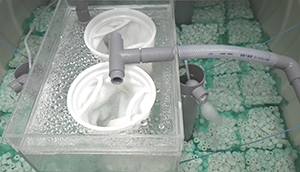
|
| Hatchery sump receiver box with airlifts at its side |
Sump
The sump is free-standing on the floor, with a non-slip sheet beneath, supported by large stainless steel plates to distribute the weight. A filter box suspended above the filter bed receives the aquarium outflow, directed through a T-junction into two large diameter filter socks, each packed with folded squares of 2 cm wide FibreMat filter material.
The skimmer input removes water directly from the filter box with the output mixing into water at the rear of the sump. A baffle arrangement of the skimmer outflow piping reduces the force of the outflow and disperses the water, preventing disturbance of the filter bed.
The filter bed is composed of net bags containing a mixture of coral pieces and cylindrical ceramic stones, resting on a layer of inert plastic corrugated sheets, perforated with small rectangular holes and supported on several upturned, slatted plastic crates.
The sump is maintained aerobic by 4 airlifts, each made from a length of VP 20 PVC pipe topped with an L-piece, located in a hole drilled at the top of a straight length of VP 65 PVC pipe. The L-piece holds the VP 20 pipe in place, with its free bottom end close to (but just clear of) the bottom of the sump. The VP 65 pipe is held vertical by passing through a hole in the supporting crates and by gluing its bottom end to the inside of a snugly fitting hole drilled in a PVC plate.
Holes drilled near the base of the VP 65 pipe allow water from the deepest part of the sump to be lifted to the surface by the 15 mm diameter air stone (length 30 mm; Sudo, Nagoya) inside the VP 20 pipe (this leaves a gap around the stone of 2.5 mm, sufficient to enable the airflow to draw water between the stone and the wall of the tube). The hose feeding the air stone passes through a tightly fitting hole at the bend of the L-piece at the top of the VP 20 pipe. The combined air/water mixture flows laterally out of the L-piece and away from the top of the air lift unit.
The sump is closed by a series of lids: the supporting board for the skimmer and 3 sheets of 5 mm transparent PVC sheet, each reinforced with 2 cm square rods of transparent PVC glued to both the outer and inner surfaces. These prevent the PVC sheets from sagging or warping. These sheets are pierced only by the skimmer inlet and outlet ports. Strips of blue synthetic sponge provide sealing to inhibit evaporative water loss at joints between the lids, which are removed for access to service the airlifts and filters.
Uses of the Hatching Facility:-
- housing a female Octopus sinensis caring for eggs laid inside an octopus pot until the eggs hatch and paralarvae are released
- housing a colony of Amphioctopus fangsiao
- performing mating experiments with pairs of A. fangsiao or Paroctopus parvus

