
[LC] = images by Leo Che
Animals . . . a brief summary of the experimental animals used at AiCephLab
|
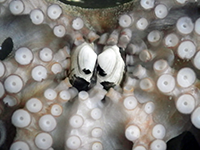
| Octopus sinensis eating a clam (Aquarium B, Lab. 2) |
Octopuses Phylum Mollusca > Class Cephalopoda > Family Octopodidae
Octopus sinensis d’Orbigny, 1841 - East Asian common octopus, ‘madako’
The main, target species for aquaculture studies at AiCephLab. This is a fast-growing species reaching up to 3 kg wet weight over 3 months of intensive on-growing conditions with ad libitum feeding.
Captured by laying out large earthenware or plastic octopus pots overnight, hauling them in the following day. Can also be caught by sturdy hand-line with an unbaited, weighted seabed lure, loaded with several large hooks and a plastic crab; or by rod and line with a smaller, simpler lure to capture smaller individuals.
|
|
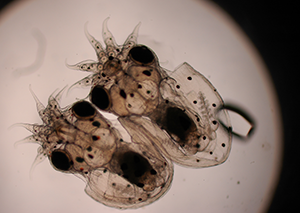
Octopus sinensis hatchlings viewed under a microscope (note 3 suckers per arm) [LC] |
Available all year round, distributed from southern Hokkaido southwards to at least Taiwan, and also reported from the Kermadec Islands north of New Zealand. Not found in Okinawa.
|
|
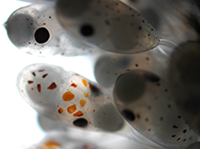
Octopus sinensis advanced embryos [LC] |
Capture forbidden during August and September, the main brooding period when eggs are laid and cared for by the females. Breeding probably occurs throughout the year since it is always possible to find females with developing eggs, although egg laying and release occur in two main seasons, in spring and autumn.
Adults are difficult to maintain in the experimental aquaria at AiCephLab and can only be accommodated individually or in small numbers in aquaria A, B and C.
At AiCephLab, the only adults maintained are brooding females. These are obtained from our research partner at Gurumeito Ltd. Brooding females stop feeding to take care of their eggs, which minimizes problems with removal of faecal matter and nitrogenous waste in our closed laboratory system of limited capacity. Individual females are maintained until the eggs hatch, when experiments on raising the paralarvae can begin.
Sausage made from the meat of the body and arms of adult O. sinensis can be used as feed for the smaller octopus species used in the laboratory.

|
|
Amphioctopus fangsiao hatchlings on artificial turf [LC] |
Octopuses - contd.
Amphioctopus fangsiao (d’Orbigny, 1841) - boiled-rice octopus, ‘iidako’
Used to help condition aquaria for subsequent introduction of O. sinensis and to perform feeding trials with novel feed. Also useful for experimenting with methods to handle and feed juvenile O. sinensis.
Found on many substrates, including open sandy areas (e.g. in Tokyo Bay off the coast of Chiba Prefecture). Easy to recognize because of a large pair of golden ocelli on the skin between arms 2 and 3, and a broad, pale, transverse patch on top of the head between the eyes.
|
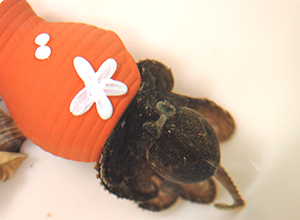
| Amphioctopus fangsiao adult resting outside a flowerpot den in the aquarium [LC] |
Caught with rod and line, using an unbaited, weighted seabed lure with several large hooks. They will basically attack any moving object on the seabed. Occur all around Honshu, Kyushu and southern Hokkaido.
Available during spring (March to May) and autumn (October to December).
A small species, with fully grown females reaching around 60 g wet weight in the laboratory, males about half that.
Accepts thawed frozen squid meat but not octopus sausage.
Easy to handle and maintain in the laboratory, especially since egg development is direct, with no planktonic stage.
Collaborative experiments on the reproductive system and mating behaviour of this species are in progress.
|
|
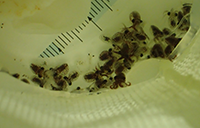
Paroctopus parvus group of juveniles feeding |
Octopuses - contd.
Paroctopus parvus (Sasaki, 1917) - Japanese bean octopus, ‘mamedako’, ‘hyadako’, ‘itako’
A small species about half the size of A. fangsiao. Fully grown adults in the laboratory reach around 30 g wet weight, the largest about the same size as a male A. fangsiao.
As laboratory animals, they are used to help condition aquaria for subsequent introduction of O. sinensis adults, juveniles and paralarvae, and to perform feeding trials with novel feed.
Useful also for experimenting with methods to handle and feed juvenile O. sinensis.
|
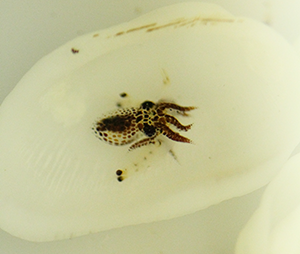
| Paroctopus parvus juvenile in a bivalve shell feeding on thawed frozen mysid shrimp |
Easy to handle and maintain in the laboratory, especially since egg development is direct, with no planktonic stage.
Found in intertidal rock crevices, where they feed mainly on bivalve and gastropod molluscs and small hermit crabs.
Caught by forcing them out of hiding using a long pipe to blow in salt, or by squirting in strong saline solution.
|
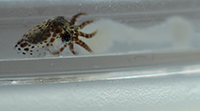
| Paroctopus parvus juvenile feeding on thawed frozen squid [LC] |
On the rocky coasts of Amakusa, they are common during October, but otherwise are rarely encountered. Distribution uncertain.
Adults accept thawed frozen octopus sausage but not squid meat. Some juveniles will eat squid but none will take pieces of octopus sausage.
Hardy and feisty, and useful for testing aquarium systems because they consistently try to escape (much more so than O. sinensis or A. fangsiao).
When handled, they grip the handler tightly and are sometimes difficult to put back in their aquarium after removing them for cleaning or experimentation.
Collaborative experiments on the taxonomy, reproductive system and mating behaviour of this species are in progress.
Squids Phylum Mollusca > Class Cephalopoda > Families Todarodinae & Loliginidae
At AiCephLab, squid are used only as a source of feed for octopuses
Todarodes pacificus (Steenstrup, 1880) - Japanese common squid, Pacific flying squid, ‘surume-ika’, ‘niban surume’
Frozen market squid used as experimental feed for octopus. So far, accepted in the lab. only by adult A. fangsiao, and some juvenile P. parvus.
An oceanic oegopsid squid species fished widely in the Japan Sea and off the Pacific coast of Japan.
Uroteuthis edulis (Hoyle, 1885) - Japanese edible squid, swordtip squid, ‘kensaki-ika’, ‘shiro-ika’, ‘ichiban surume’
As with T. pacificus, obtained as fresh market squid, frozen and used as experimental feed for juvenile octopus (mainly by adult A. fangsiao).
A myopsid squid species found closer inshore than T. pacificus and confined mostly to western and southern Japan, off Honshu, Kyushu and Shikoku, and in the East China Sea.
|
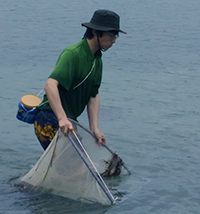
| Leo hunting for Idiosepius |
Squids - contd. Phylum Mollusca > Class Cephalopoda > Family Idiosepiidae
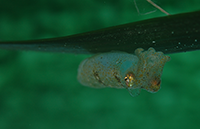
Idiosepius cf. paradoxus (Ortmann, 1888) - Japanese pygmy squid, ‘hime-ika’
|
|
Idiosepius cf. paradoxus beneath seagrass blade [LC] |
Tiny squid with a life cycle of only 3 months or so. Found associated with seagrass beds around Japan. Collected from Onagawa Bay for experiments at AiCephLab.
The subject of research by Leo Che, who is trying to raise this locally-obtained species through the complete life cycle in the laboratory, in addition to performing experiments on the digestive system.
Bivalves Phylum Mollusca > Class Bivalvia
Mizuhopecten yessoensis (Jay, 1857) - Japanese scallop, ‘hotate gai’
Ruditapes philippinarum (Adams & Reeve, 1850) - Short-necked clam, ‘asari’
Shelled meat from these two bivalve species is stored frozen and used as feed for on-growing of young adult O. sinensis. Not accepted by A. fangsiao or P. parvus.
Fish Phylum Chordata > Superclass Pisces > Order Perciformes (perch-like fish - 40% of all fish are in this group)
Ammodytes personatus Girard, 1856 - Pacific sand-lance, ‘ikanago’
Adults used as feed for juvenile and adult octopus. Juveniles may be fed to young octopus. Long associated with attempts to culture O. sinensis in Japan.
Crabs Phylum Arthropoda > Class Crustacea > Order Decapoda > Infraorder Eubrachyura
Hemigrapsus spp. - Asian shore crab, ‘isogani’
Small but aggressive and highly successful. There are about 16 species of Hemigrapsus world-wide. Three are native to Japan: H. penicillatus, H. sanguineus and H. takanoi. Bred as bait for recreational fishing.

|
|
Hemigrapsus sp. in mating aquarium |
|
|
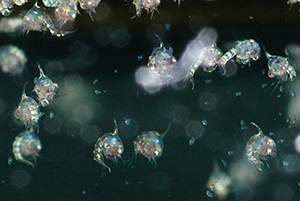
Newly hatched Hemigrapsus zoeae (½ mm body; 1 mm total length) [LC] |
Recently, both H. sanguineus and H. takanoi have been identified as rapidly invasive species in many countries, including parts of Europe and the USA. Genetic analysis shows that these invasive populations originated in Japan. They were probably introduced in ship ballast water.
Used at AiCephLab as a source of zoea larvae to feed to planktonic hatchling O. sinensis. The zoeae are greatly attracted to light and move very quickly (note the blurred track of a moving zoea near the centre of the accompanying image). The meat and minced internal organs of Hemigrapsus males and spent females are used as a feed supplement for juvenile octopuses.
Another small species of crab, Gaetice depressus (De Haan, 1833), is sometimes captured on the same shores as Hemigrapsus. The zoeae, meat and minced internal organs of this species, too, are used for feeding to juvenile octopuses.
Scopimera globosa (De Haan, 1835)- Sand bubbler crab, ‘kometsukigani’

|
|
Scopimera globosa (body width about 8 mm) |
Much smaller than Hemigrapsus and Gaetice, this species lives in burrows in the sandy mud of brackish tidal flats. Large numbers of them can be observed on the surface when the sand is exposed at low tide, quickly scurrying into their burrows when approached. To catch them, a small trowel is used to pile sand into sieve. When the sand is washed away, these small crabs are left behind and can be collected in a bucket. They are small enough to be fed to juvenile octopuses.
From July to August, many S. globosa zoeae hatch and can be caught in large numbers with small plankton nets of an appropriate mesh size. These zoeae can then be transported back to the lab. and used directly as feed for developing O. sinensis paralarvae.
A characteristic of this species is to hold the large clawed limbs under the body (when not fighting, defending itself or manipulating sand). So the claws cannot be seen on the living specimen shown in the image: the clawed limbs are held directly down beneath the body on each side, forming what appear to be the two lumps at the front of the head, just in front of the well-camouflaged eyes. The brown and orange colour and markings of the skin of the arms and body blend perfectly with the sand on which it lives. The hard covering of the body and limbs is actually a pale yellow colour and is all that will remain once an octopus has finished feeding on it.
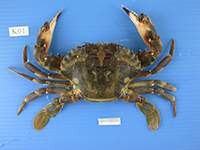
Portunus (Portunus) trituberculatus (Miers, 1876) - Japanese blue crab, ‘gazami’ or ‘watari-gani’
Indo-West Pacific species, the most widely fished crab species in the world.
|
| Portunus trituberculatus (dorsal view: body width about 110 mm) |
|
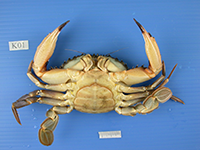
| Portunus trituberculatus (ventral view) |
A large species investigated for its possible contribution of zoea larvae to young planktonic O. sinensis. However, our sampling results so far have not detected the larvae of this species among the prey organisms eaten by wild O. sinensis paralarvae in the Amakusa area.
Nevertheless, experiments are in progress elsewhere (not at AiCephLab) for production of P. trituberculatus zoea larvae to feed to cultured octopus paralarvae. Breeding adults of this species kept at AiCephLab for up to six months failed to maintain any eggs through to hatching, so we have abandoned using this species except as a source of nutritional supplement in octopus feed.
True Shrimps Phylum Arthropoda > Subphylum Crustacea > Class Malacostraca > Order Decapoda > Suborder Pleocyemata > Infraorder Caridea
|
|
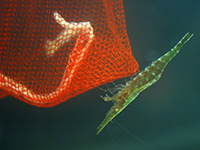
Shrimp Heptacarpus sp. at rest on net [LC] |
Heptacarpus sp. - Grass shrimp, glass shrimp, ‘koshimagari-koebi’
A shrimp genus commonly found in sea grasses around Japan. Specimens at AiCephLab were collected from Onagawa Bay with a hand-hauled seine through an inshore seagrass bed.
These shrimps can be successfully maintained in the lab. if algae are provided. They are one of several possible feed species for adult pygmy squid. Interestingly, they can gradually change their colour and body shape to match the various forms of sea grass that occur over the changing seasons.
Palaemon paucidens (De Haan, 1844) - Lake prawn, ‘suji-ebi’
A freshwater shrimp in rivers and lakes around Japan, where it is cultured for food in certain regions. 'Suji-ebi' means striped shrimp.
This species is relatively easy to keep and can survive long enough in salt water to be consumed by octopuses.

|
|
Shrimp Neomysis sp. on a millimetre scale [LC] |
Peracarid Shrimps Phylum Arthropoda > Subphylum Crustacea > Class Malacostraca > Superorder Peracarida (shrimps with a brood pouch)
Mysid Shrimps Superorder Peracarida > Order Mysida
Neomysis awatschensis (Brandt, 1851) - ‘isaza-ami’
This mysid is relatively easy to obtain, and at AiCephLab is used as the main source of feed for rearing pygmy squids in the lab.
Lives in low-salinity brackish water but can survive long enough in full sea water to be consumed by the pygmy squid. Neomysis awatschensis can be reared on Artemia nauplii and will reproduce in the lab. if conditions are suitable.

|
| Amphipod shrimp Aroui onagawae [LC] |
Amphipods Superorder Peracarida > Order Amphipoda
Aroui onagawae (Takekawa & Ishimaru, 2000) - ‘yoko-ebi’
Amphiopods are laterally flattened shrimps sometimes called sideswimmers. There are nearly 10,000 described species, mostly detritivores or scavengers. Their appendages are in two major forms, hence the name ‘amphi-’ (on both sides, two) ‘poda’ (feet). They are available in large numbers for much of the year and are fed on readily by octopus juveniles.
Isopods Superorder Peracarida > Order Isopoda
Eurydice orientalis Hansen, 1890 - ‘suna-hori-mushi’

|
| Isopod [LC] |
Isopods are another diverse crustacean group, with around 10,200 described species, 4,500 of which are marine. They may be scavengers, filter-feeders, predators or parasites, particularly external parasites of fishes. On land, they are familiar as wood lice (pill bugs), and on the seashore as the so-called sea roach, Ligia. Each body segment has paired appendages similar in size and appearance, hence the name ‘iso-’ (same) ‘poda’ (feet). They are typically flattened dorso-ventrally (i.e. flattened between their back and underside).
Since they are carnivorous, they can be caught in traps (screw-top jars with holes in the lid) baited with fresh pig liver. As with amphipods, they are 5-10 mm in length and are readily eaten by octopus juveniles.
Brine shrimps Phylum Arthropoda > Class Branchiopoda > Order Anostraca
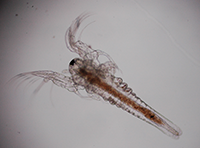
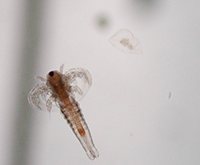
Artemia tibetiana Abatzopoulos, Zhang and Sorgeloos, 1998 - Tibetan brine shrimp, ‘arutemia’
 |
|
Artemia tibetiana nauplius - note the naupliar eye (black spot at the front) [LC] |
|
|
Artemia tibetiana nauplius photographed against a mm scale — body length about 1mm [LC] |
Used as feed for crab zoea larvae (e.g. newly hatched Hemigrapsus). Some aquaculture research groups also use Artemia directly as feed for hatchling O. sinensis, but currently not at AiCephLab.
Brine shrimps can be supplemented with various nutrients to provide better nutrition for the target animals to which they are being fed. However, these supplementary nutrients may not be retained for long in the brine shrimps before being metabolized or released as faeces.
Artemia tibetiana naturally contains more PUFAs suitable for octopus paralarvae than are found in other artemia species such as A. franciscana or A. salina (ref.) but, in our experience, octopus paralarvae do not survive well on Artemia however they are supplemented.
Rotifers Phylum Rotifera > Class Eurotatoria
Branchionus plicatilis Müller, 1876 - Rotifer, ‘wamushi’
Rotifers are used widely in the aquaculture industry. At AiCephLab, they are used as feed for mysids and crab larvae.
Useful because of their consistent small size, which means they do not outgrow their predators (crab and prawn larvae may outgrow their intended predators, disastrously reversing roles and feeding on the intended predator species).
They can also be supplemented with PUFAs to improve nutrient input to Artemia and thence planktonic octopuses.

|
| Apostichopus japonicus feeding at front of aquarium [LC] |
Sea cucumbers Phylum Echinodermata > Class Holothuria
Apostichopus japonicus (Selenka, 1867) - Japanese common sea cucumber, ‘ma-namako’, red ‘namako’, green ‘namako’, black ‘namako’
A sea cucumber of modest size, heavily fished in Japan and particularly prized as a delicacy in China, where it is intensively cultured (ref.).
A temperate species of sea cucumber. Found on the coasts of the western North Pacific from Russia to the East China Sea. Goes into aestivation if seawater temperatures approach 25°C. Unlike many other species, it does not release defensive saponins, which can kill animals such as octopuses in the confines of a culture tank.
Under investigation at AiCephLab for possible use as a polyculture organism.
Parasites
|
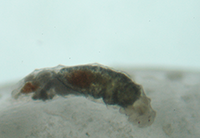
| Parasite on egg of Octopus sinensis [LC] |

|
| Parasites inside an octopus egg [LC] |
A number of parasites have been observed on and inside the eggs of Octopus sinensis. These have not been identified yet.
They seem to be common and are likely to be one of the factors contributing to the high mortality during the early stages of octopus development. All the various factors contributing to octopus mortality require careful monitoring to understand more fully the processes occurring during development. These factors can then be manipulated to ensure that survival is maintained at levels supporting commercially viable octopus aquaculture.

 Last site update: 14th June, 2018
Written by Ian Gleadall & Leo Che
(coded & validated by Ian Gleadall)