
Activities . . . (the basic AiCephLab research themes are listed elsewhere)
|
Aquarium development - construction and modification of existing systems
The aquaria at AiCephLab were built with certain experimental objectives in mind but the facilities available also have their own constraints, which have influenced the aquarium system designs. In addition, as experiments have progressed, objectives have changed and subsequent modifications have been made.
To a great extent, then, aquarium development has been, and still is, a continuous process at AiCephLab.
Modifications currently under way involve the introduction of macroalgae to the aquarium circuit. These will remove nitrogen-containing compounds produced as waste products by the animals held within the aquaria.
Sampling - with Masumi Abe, Keiji Matsubara & Dr Goh Nishitani
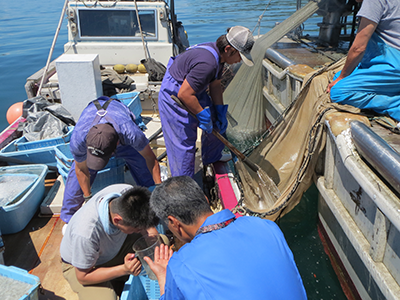
To address problems with raising planktonic octopuses, we go sampling to obtain plankton in the area where adult octopuses are found. At certain times of the year, wild planktonic octopus hatchlings can be found in the nets of whitebait seiners.
|
|
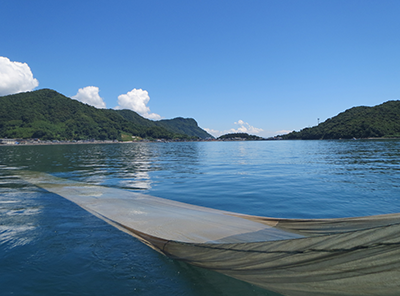
Hauling in the whitebait seine. The cod-end of the net is like a long sock |
|
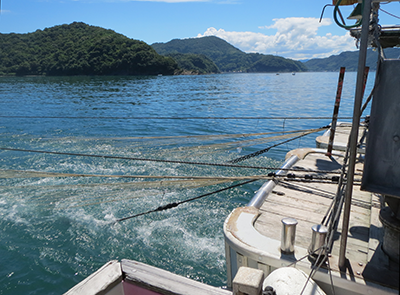
| The twin whitebait seine boats haul in the net together. The support vessel is along side |
|
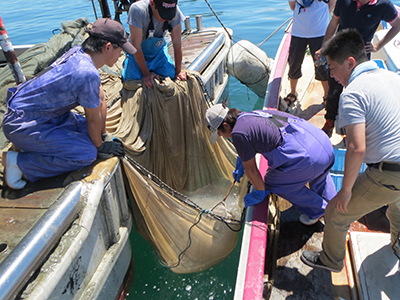
| Whitebait is scooped out of the net by hand and placed in crates in the support vessel (to the right, now astern of the twin seine boats) |
|
|
On the support vessel, seawater with the whitebait is inspected to separate out any octopus paralarvae (the seine boats are on the right in this photograph) |
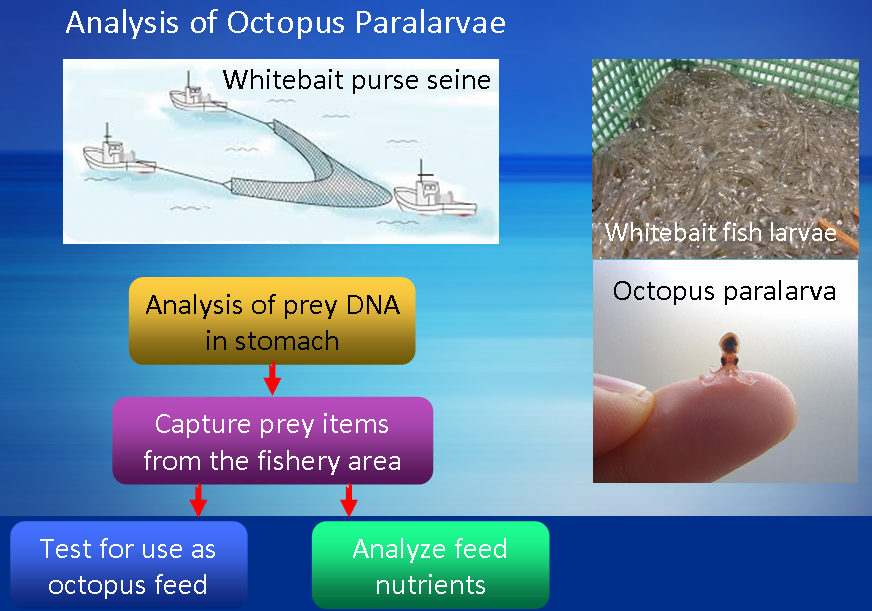
We also go sampling for wild plankton, to discover more about the availability and timing of different planktonic organisms and to experiment with using some of these organisms as feed for paralarval octopuses during experiments.
|
Analysis - with Prof. Masazumi Nishikawa & Dr Goh Nishitani
Analysis of the paralarvae obtained by sampling of wild populations includes two main approaches. One is to analyse the nutritional components that make up the body of paralarvae.
Knowing the amino acid and fatty acid content at different stages of development can provide clues to the most appropriate feed to provide for maximum growth and survival.
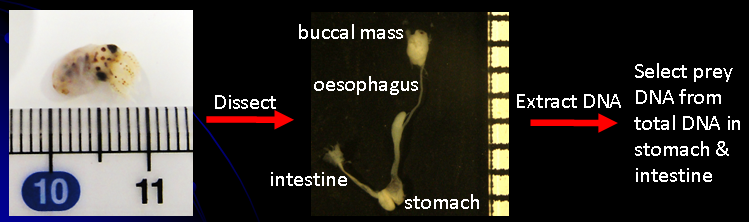
Another analysis that we perform is on the gut contents of the paralarvae to identify the organisms on which they feed in nature. To do this, paralarvae collected from a whitebait seine are dissected to remove the oesophagus, stomach and intestine.
|
| Procedure for extracting and analysing the gut contents of Octopus sinensis paralarvae |
Each alimentary canal thus obtained from the paralarvae collected is then opened under sterile conditions and the contents carefully removed. Processing of this material allows us to obtain sequences of the DNA present.
A BLAST search can then match the sequences obtained to the GenBank database of DNA sequences. Unavoidably, some of these sequences are from the tissues of the octopus from which the samples were obtained. However, the remaining DNA is from the prey species eaten by the paralarvae, so we can use this to identify the particular animal species that was eaten by each paralarva.
Care of octopuses: care and maintenance of paralarvae - with various student volunteers & part-time helpers
The major problem facing aquaculture of Octopus sinensis is the care and maintenance of the planktonic paralarvae until settling. This is demanding because the prey animals eaten during natural development are largely unknown.
Therefore, it is necessary to prepare a number of different possible feed items to present to the paralarvae at different stages of their development and to compare the nutritive state of wild and aquacultured animals.
Paralarvae at different stages of development are fed on various diets and then harvested for analysis. Analysis includes qualitative and quantitative assessment of amino acid and fatty acid content. Such data provide clues as to modifications in diet that may improve survival of the paralarvae.
|
| Feeding Paroctopus parvus juveniles kept in small pots |
Care of octopuses: juveniles
Once the paralarvae have completed their life as planktonic, swimming animals, they eventually settle on the seabed in nature, and the floor of the aquarium if in aquaculture.
These juveniles require different feeding and accommodation from the paralarvae. Paralarvae are active swimmers and live their life in a 3-dimensional world, while juvenile octopuses are at the beginning of the octopus's typical 2-dimensional life on the seabed.
This transition and transfer to different life style and feeding habits is known to be another cause of high mortality during the life cycle of O. sinensis.
To gain information about the needs of juveniles, we use species with direct development (with no planktonic stage) as models to learn more about how to raise juveniles successfully with maximum survival.
Care of octopuses: adults
At AiCephLab, it is not feasible to accommodate more than one or two adult O. sinensis because of their relatively large size. However, we look after several small species of octopus which have adults the size of the older juveniles of O. sinensis.
The adults of these smaller species can be obtained relatively easily. Also, they have no planktonic stage because the eggs hatch directly into relatively large, seabed-dwelling baby octopuses. This is in direct contrast to obtaining O. sinensis juveniles, which can only be obtained by first raising them through the planktonic stage.
The young and adults of small octopus species can therefore be used to try out experimental aquarium systems and different feed items in readiness for raising O. sinensis juveniles with confidence once rearing techniques have progressed.
|
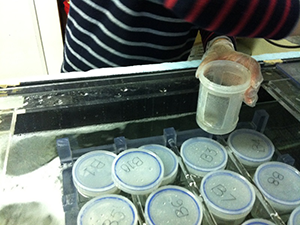
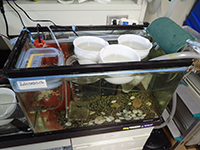
| Containment of crab larvae |
Care and maintenance of prey organisms - with Leo Che
In order to grow and remain healthy, octopuses require a large and consistent supply of animal protein and other nutrients. During the paralarval and early juvenile stages, a supply of living animals is vital to ensure high survival.
Feeding with dead meat or other products is possible, but the octopuses do not grow well and mortality rises quickly.
Therefore, it is necessary to maintain a supply of suitable animals to fill this need during the early stages of octopus development. Such animals include:-
- adult crabs (for feeding to young adults, and to produce larval crabs)
- larval crabs (particularly the zoea stage, to feed early paralarvae)
- adult and larval shrimp (to feed to late paralarval and juvenile octopuses)
- larval shrimps (particularly the mysis stage, to feed to paralarvae)
- brine shrimp (particularly the nauplius stage, to feed early paralarvae)
- rotifers (to supplement the nutritional state of brine shrimp)
- amphipods (to feed to early juvenile octopuses)
- isopods (to feed to late juvenile octopuses)
Mating experiments - with Dr José Marian & students on the AMB course
|
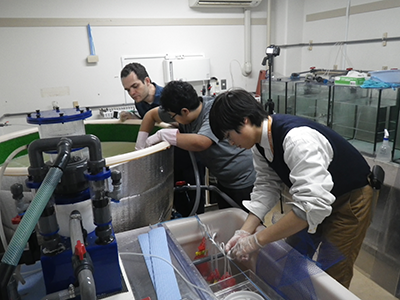
| Preparing for octopus mating experiments in Aquarium A |
Following the CIAC International Workshops and Conferences in Hakodate in November, 2015, Dr José Marian visited AiCephLab for collaborative research on cephalopods. At the time, we had lively stocks of two species of octopus which were ideal subjects to observe mating and to investigate the fate of spermatophores following transfer to the female.
The AiCephLab objectives with these small species were:
- to condition the aquaria to hold octopus adults and paralarvae
- to investigate suitable feed and techniques for culturing octopuses in land-based, closed-circulation systems
- to obtain eggs and raise them through the juvenile stage to adulthood, to gain experience in preparation for subsequent raising of Octopus sinensis
The species we held in captivity were Amphioctopus fangsiao and Paroctopus parvus. There were problems with escapes by P. parvus, so they were being held in individual containers and fed by hand. There had also been a problem with cannibalism during the initial stage of culturing the A. fangsiao colony, so they had been confined to a nest each (a Japanese teacup on its side) in individual large netting bags in Aquarium A, to monitor their growth as well as to prevent further cannibalism.
The fact that the octopuses had been kept in isolation for several weeks prior to mating meant that the octopuses would mate very quickly after a male and female were placed together in the same aquarium. So, despite the short time that José was with us, we were able to accomplish multiple matings, observing the behaviour of the two species of octopus, as well as making good preparations of spermatangia soon after mating, and observations of the spermatophore reaction, which releases the sperm ready for fertilization.
Macroalgae experiments - with Dr Kinuko Ito
The term aquaculture usually brings to mind the raising of many individuals of a single species to sell as human food. However, it has long been recognized that polyculture (raising a number of different species of plants and animals together) is important.
Polyculture makes use of plants to remove inorganic wastes and release extra oxygen into the water. In marine systems, this typically means the introduction of macroalgae (seaweeds). If these seaweeds can also be harvested, the commercial output and profit for the enterprise is further increased beyond having healthier target animal species raised in a more stable environment.
Since the experimental facilities at AiCephLab rely on recirculating seawater, the introduction of macroalgae into the system will help maintain low levels of dissolved inorganics such as nitrates and ammonia. Conditions for the animals in the system will then be improved.
Experiments have been performed using representative species of macroalgae from several different groups, including red, green and brown algae. These were all assessed for their nitrogen-absorbing activities from seawater fortified with extra nitrates. Reduction of nitrate levels was then monitored over a period of two weeks, at 20°C (which is the temperature at which Octopus sinensis is typically maintained in aquaculture at AiCephLab).

|
| Gracilaria texitorii experiment |
|
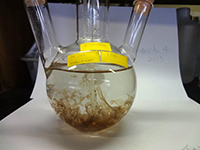
| Pyropia tenera experiment |
|
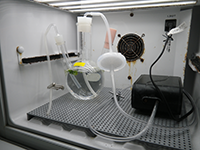
| Ulva australis experiment |
The following macroalgae were assessed (all are included in the plant kingdom - Kingdom Plantae - except Saccharina, which is in the Kingdom Chromista):-
- Caulerpa cf. microphysa (Phylum Chlorophyta > Class Ulvophyceae > Order Bryopsidales; sea grapes, ‘umi-budō’). (For more information about this species, see the Plants page)
- Ulva australis (Phylum Chlorophyta > Class Ulvophyceae > Order Ulvales; synonyms include Ulva pertusa, ‘ana-aosa’)
- Gelidium johnstonii (Phylum Rhodophyta > Class Florideophyceae > Order Gelidiales; synonyms include Gelidium koshikianum, ‘Satsuma tengusa’)
- Gracilaria texitorii (Phylum Rhodophyta > Class Florideophyceae > Order Gracilariales)
- Pyropia tenera (Phylum Rhodophyta > Class Bangiophyceae > Order Bangiales; synonyms include Porphyra tenera, ‘asakusa’, ‘amanori’)
- Saccharina japonica (Phylum Ochrophyta > Class Phaeophyceae > Order Laminariales; synonyms include Laminaria japonica, ‘makonbu’)
This code functions to keep CONTENT above its footing horizontal rule and above CONTENT FOOTER section

