
People at AiCephLab . . .
Ian Gleadall - Head of Unit and Executive Director of AiCeph LLC, Sendai

From . . .England, resident in Japan
While establishing this independent research unit (formerly part of IFSU, the International Fisheries Science Unit), I have received the kind help of a number of people. In particular, I have been very fortunate to have access to a group of bright undergraduate students studying on the Applied Marine Biology course. Also, I have been fortunate to be part of a growing movement in Japan, and indeed around the world, attempting to conquer the problems of raising octopuses in the Octopus vulgaris group at a commercial level. Among the many people I must thank for their support, collaboration and friendship, I would particularly like to mention the following:-
|
|
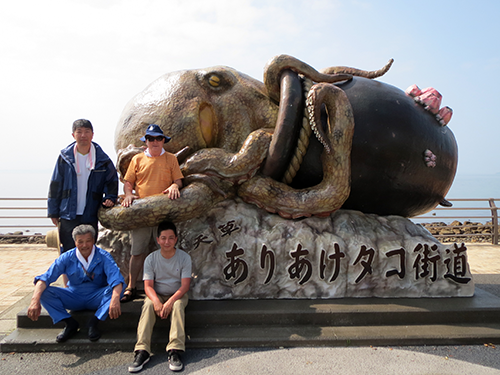
Giant effigy of Octopus sinensis in an octopus pot (‘tako tsubo’) with four members of the JST Octopus Aquaculture Group |
- Masumi Abe (Gurumeito Ltd., Ishinomaki)
- Dr Eric Edsinger (MBL Josephine Bay Paul Center, Woods Hole, USA)
- Drs Ángel Guerra, Ángel F. González & Álvaro Roura (Instituto de Investigaciones Marinas de Vigo, CSIC, Vigo, Spain)
- Dr José Iglesias (formerly at the Instituto Oceanográfico de Vigo, Spain)
- Keiji Matsubara & Morio Sase (Hotland plc, Tokyo)
- Prof. Carlos Rosas (Programa Pulpo, Universidad Nacional Autónoma de México, Sisal, Yucatán)
- Koji Wada (Blu Harbor Ltd.,Osaka )
. . . my research collaborators here at Tohoku University . . .
- Dr Goh Nishitani
- Dr Kinuko Ito
. . . and elsewhere . . .
- Dr José Marian (University of São Paulo, Brazil)
- Prof. Jonathan Miller (OIST)
- Prof. Masazumi Nishikawa (Miyagi University, Sendai)
- Prof. Nobuhiko Akiyama (Tokai University, Shimizu)
I also thank: Aki Hamamoto (the scientific illustrator who has provided a very valuable service in her work with me over many years); Jessica Gordon & Courtney Timmons (for their highly competent technical help with my work at OIST); Leo Che and Moemi Kanno (my very competent and enthusiastic research technicians here at AiCephLab);

Hiroto Teranaka, Hiroki Takahashi & Kazuaki Uehara at Kami-Amakusa City Hall (for their help with collecting octopuses); and my student volunteers: Qarri Ainaya, Leo Che, Germaine Lau, Naomi Hadisumarto, Freeha Khalid, Harini Nishshanka, Anh Ngo, Tipsirin ‘First’ Phonpaipal, Delta ‘DP’ Putra, Dewi Setyaningrum & Jialing Shen.
The research taking place in this unit is funded by small running-cost internal grants from the Graduate School of Agricultural Science in addition to major funding from the Japan Science & Technology Agency (grant nos. J130000263 & AS2715164U).
Moemi Kanno - Research Technician*

|
| Moemi |
From . . .Sendai
Contribution (90% experiments/animal feeding/lab. maintenance, 10% admin.)
- Overview of tidiness & maintenance of labs.
- Aquaria maintenance
- cleaning and servicing of aquaria
- checking water parameters (salinity, temperature, nitrate, ammonia)
- changing filters, cleaning airstones & skimmers
- Help with hatching, raising and feeding Artemia, crabs, shrimps
- Feeding juvenile & adult octopuses
- Admin.
What I have enjoyed about working in this unit: I'm interested in this work because my career ambition is to be an aquarist. I had never handled octopuses before I began this job. I did not realize they are so intelligent. I really enjoy feeding them, especially the juveniles. It has been great to watch them grow from tiny juveniles into young adults. Their behaviour is so interesting. They learn quickly and each octopus seems to have its own personality and preferences for food. Learning about aquarium systems and how to run them, too, has been an interesting experience. (*Moemi is currently working at Gurumeito Ltd., Ishinomaki, as an octopus aquaculture research technician).
Leo Che - Research Technician*
|
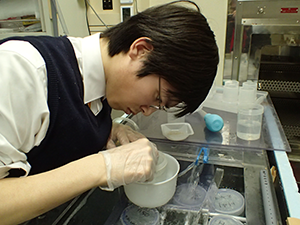
| Leo feeding juvenile Paroctopus parvus |
From . . .San Jose, California, USA
Contribution
- Caring for paralarvae of Octopus sinensis
- Rearing adult and juvenile Amphioctopus fangsiao and Paroctopus parvus
- Reproduction, care and feeding of feed animals
- mysid shrimp
- crabs & crab zoeae
- amphipods
- isopods
- Artemia
- Photography
- Help with aquarium maintenance, construction, modifications and repairs
- Group Manager for the Cephalopod Aquaculture Research Lab Google group
What I have enjoyed about working in this unit: I like being able to work with marine animals and learning about their behaviour and development. I also enjoy looking at and understanding how systems work, which made jobs in building and designing aquarium systems interesting to me. These kinds of tasks are the kinds of things I wanted to explore as a child, which I am now able to do here. It has been an eventful journey in this unit but the challenges, the frustrations, the failures, the successes, these are the things that have made and continue to make life worth living and tomorrow worth seeing. I'd like to remain to see this out to it's completion, no matter the outcome. Perhaps, someday, I'll come to teach others what I have learned and will learn through my time here. (*After working as a research technician at both Tohoku University and the Hotland Octopus Aquaculture Research Centre in Kami-Amakusa, Kyushu, Leo is currently back in the USA preparing to enter university to study Engineering).
Germaine Lau - Undergraduate Student Volunteer*

|
| Germaine |
From . . .Singapore
Contribution
- Help with construction of initial aquaria systems
- Culturing Artemia
- Feeding octopuses
- Mating experiments (Amphioctopus fangsiao and Paroctopus parvus)
- Artemia enrichment liposome experiments
What I have enjoyed about working in this unit: From collecting octopuses (by fishing), to feeding them, it was an interesting experience to handle an organism from the adult stage to its spawning and subsequently larval/juvenile stages. Getting hands on experience enabled me to understand what working in a laboratory means, since I had no prior experience of doing so. (*Germaine obtained a Masters degree at Tokyo University of Marine Science and Technology and is currently working at the Aquaculture Innovation Centre in Singapore).
Delta ‘DP’ Putra - Undergraduate Student Volunteer*

|
| Yakiniku dinner Left to right: "First", Germaine, Leo, Ian, DP |
From . . .Kediri, Indonesia (residing in Bogor just before coming to Japan)
Contribution
- Cleaning of octopus aquaria
- Feeding and weighing octopuses
- Devising methods to grow and develop Artemia tibetiana
- Fishing for Amphioctopus fangsiao
- Constructing the frame to support the system for aquaria D~G
- Helping with other construction, maintenance, modification and repair jobs
What I have enjoyed about working in this unit: Before coming here, I had never seen an octopus directly. Octopuses are fun and interesting, sometimes aggressive, sometimes graceful. They have impressive agility, both when they are swimming or sitting on the bottom/seabed. I also enjoyed working with Artemia tibetiana. (*DP is currently completing work towards a Doctoral degree).
Naomi Hadisumarto - Undergraduate Student Volunteer*
|
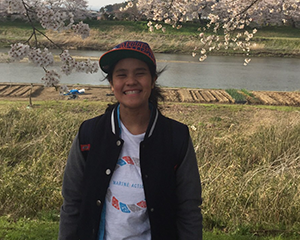
| Naomi |
From . . .Jakarta, Indonesia
Contribution
- Feeding juvenile Amphioctopus fangsiao and Paroctopus parvus
- Culturing feed, including Artemia, shrimps and sea cucumbers
- Help with design and maintaining aquaria systems
- Help with mating experiments
- Help with weighing octopuses for growth data
What I have enjoyed about working in this unit: I found it very interesting to begin to understand the components and factors that need to be considered when culturing animals in the laboratory, and I feel this experience has improved my skills as a biologist. (*After gaining her Masters degree, Naomi is currently involved in postgraduate research).
Harini Nishshanka - Undergraduate Student Volunteer*

|
| Student line-up Left to right: Leo, Anh, Harini, Jialing, Freeha, Chairul |
From . . .Colombo, Sri Lanka
Contribution
- Helped build up the aquarium systems from scratch
- Conditioned aquaria A~C by maintaining the first Octopus sinensis to arrive at AiCephLab
- Rearing of O. sinensis paralarvae
- Hatching and rearing of Artemia
What I have enjoyed about working in this unit: I really loved getting to know about octopuses and their uniqueness. Moreover, it was a very valuable experience for me doing not only rearing but coming up with experimental plans on how to proceed with octopus aquaculture, which was a very new subject at the time for the species we were trying to culture. (*Harini is currently working towards a PhD after gaining a postgraduate Diploma in Climate Change and Environmental Management at the University of Colombo, with extensive experience working on programmes for the International Union for Conservation of Nature (IUCN), the United Nations Development Programme (UNDP), and the Sendai Framework for Disaster Risk Reduction).
This code functions to keep CONTENT above its footing horizontal rule and above CONTENT FOOTER section

