
The Crab Lab. (the ‘Green Room’)
|
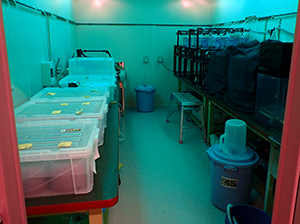
| Crab Lab from doorway. Left: crab larvae culture units. Right: crab adult culture system. |
Introduction
The Crab Lab.* is situated in one of a pair of constant temperature and humidity rooms in Room N107.
The main focus of this lab. is the culturing of small shorecrabs, particularly species of the genus Hemigrapsus. This genus contains Asian species common in Japan which are aggressively invasive in other countries. An attempt is being made here to harness the features facilitating their success as invasive species (ref.).
One side of this lab. houses a modified system adapted from one (previously at Amamiya) that was built into a concrete bench. Here at Aobayama campus, two sturdy steel-framed wooden tables are used instead of the bench. There are two cubic glass aquaria (H & J), and accommodation for twenty 1- or 2-litre aquaria on supporting frames designed to maintain small shore crabs until developing eggs are detected under the abdomen of females.
On the other side of the room, small customized bench-top aquaria are used to harvest zoea larvae released from egg-bearing females. These larvae are then raised until ready for feeding to octopus paralarvae; or for further culturing to the juvenile crab stage for feeding to settled octopus juveniles.
All electrical connections pass through safety circuit breakers at the mains sockets. All seawater is artificial, made using deionized tapwater and Instant Ocean synthetic sea salt supplemented with 90 µmol. l.-1 Strontium chloride (ref.). The in-line water filters are all wound polypropylene fibre, 5 µm (AsOne FPP-05-1), mounted in an Organo Model III 250 mm housing.
The in-line system includes two filters, one inserted immediately downstream of the UV sterilizer as a precaution to remove any activated particulate matter leaving the sterilizer. In particular, (i) an anecdotal account has suggested that aquarium animals are irritated by water that has passed through a UV sterilizer; and (ii) it is known that certain water-borne organics can be rendered more toxic after passing through a UV sterilizer (ref.).
*[The Crab Lab. began as part of Lab. 1 (along with the Hatchery) at Amamiya (the former campus) and was moved to new facilities at Aobayama campus in February, 2017].
Laboratory Environment
The Crab Lab. is a constant-temperature room (NK System, Tokyo) currently set to 25°C on an automatic light/dark (LD) cycle of 12 hours dark and 12 hours light (LD 12:12). The cubic aquaria H and J are covered with light-tight shrouds and set to long and short photoperiods of LD 14:10 and LD 10:14, respectively. To reduce the light intensity of the standard fluorescent lighting, all light mountings are covered with sheets of green filter (Lee 735, Velvet green). As well as greatly reducing light intensity, this filter effectively cuts out both red and blue light, preventing the growth of microalgae within the aquaria and tubing. This light regime is considered to lessen stress on the crabs (and also on the technicians, since it reduces the effort required to maintain a clean and efficient system).
Aeration of Aquaria
A single AP-80 air pump (Yasunaga, Tokyo) provides all the aeration in the lab. (80 litres per minute at full capacity), transferred through a system of VP-13 PVC piping (along three of the walls) with stainless steel taps screwed into holes drilled at intervals and sealed with Esron PVC glue (Sekisui Chemical Engineering, Tokyo). The air intake filter is cleaned every 3 months or so.
A bleeder outflow pipe is included to avoid excessive pressure within the system and as a safeguard against water sucking back to the pump in the event of a power failure. This bleeder pipe has its own cock for pressure adjustment and is plugged with a piece of filter material as a sound baffle.
|
|
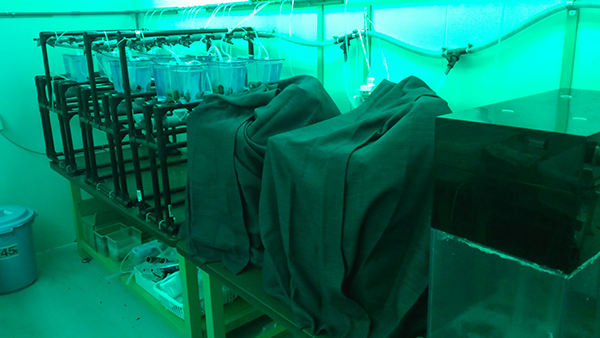
Crab Lab. main aquarium system. From left to right: Aquaria 1~20; Aquaria H & J (shroud-covered); & sump with black-box unit mounted above it. |
Circulating system: Specifications
| System total capacity: | around 350 litres |
| Aquaria: |
|
| Sump: | 60 litres working capacity, transparent PVC with lid |
| Main circulation: | Sanso PMD 421B2E pump |
| Protein skimmer: | MRC Recirculating Protein Skimmer, model MR-2R |
| Skimmer feeder pump: | Sanso PMD 421B2E pump |
| Skimmer recirculation pump: | Rei-Sea RMD 551 Pump |
| UV sterilizer: | Iwaki UVF-1000 |
| Heaters: | Not required |
| Cooler: | Zensui ZR-75E |
| Pump for cooler circuit: | eHeim Professional 3 |
Circulating system: Construction
|
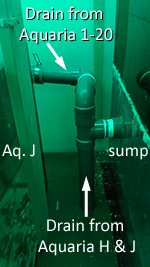
| Drainage arrangement for the Crab Lab. system |
All aquaria outflows drain into a system of VP-40 PVC pipes partially built into a sturdy steel-framed wooden table and adjacent sink. The outflow for each of the two large glass aquaria (H & J) is in the rear right-hand corner of the aquarium base. This is located onto the drainpipe and sealed with a ring of packing material. The drainpipe passes down through the table to a common horizontal drain, which rises back up through the table to enter the sump. At the point of entry to the sump, the rising drain from aquaria H & J is joined by the elevated drain descending from the rack system of small aquaria (1~20).
|
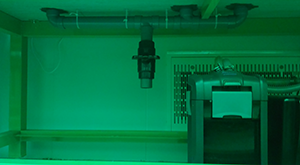
| Horizontal drainpipe connecting aquaria H & J outflow to the sump |
The water at the bottom of each of aquaria H & J flows through slits in the lower part of the wall of a small compartment housing a VP-40 PVC stand-pipe. Water flow is maintained by having the outflow into the sump lower than the height of the stand-pipe inside each aquarium. Emergency overflow from the sump opens into the adjacent sink.
|
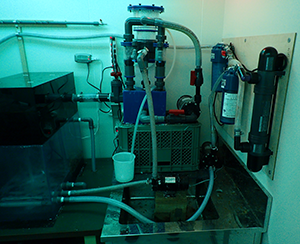
| Sump, skimmer & pumps for aquaria H, J and 1~20 |
From the sump, the water circuit is powered by a pump resting on blocks inside the sink. Outflow back to the aquaria passes to a wall-mounted wooden board holding a UV sterilizer between two in-line filter units. Water then passes along a wall-mounted pipe with branches to each of the aquaria. The main pump circuit is a mixture of VP-16 PVC piping and braided flexible hose. A cooler served by its own pump cools water in a separate circuit out of and back to the sump.
The protein skimmer is served by a combination of VP-16 and VP-20 pipes. It is mounted over the sink on a sturdy PVC plate. Sufficient height for skimmer operation above the sump is provided by mounting the skimmer raised on an upturned crate. Outflow from the skimmer enters a sealed black PVC box, the base of which opens directly into the front compartment of the sump. This black box above the sump is a light-tight unit with its own full-spectrum LED light source allowing macroalgae placed within to grow and help reduce the levels of phosphate and nitrate within the system.
Aquaria H & J and the sump all have a layer of insulation beneath to reduce heat transfer. This insulation is sandwiched between two layers of non-slip matting to deter horizontal movement in the event of an earthquake.
The sump unit has front and rear compartments separated by a partition open only at the base. The filter bed (composed of loose, cylindrical ceramic stones) in the rear compartment rests on a perforated plate suspended a few cm above the level of the opening in the partition.
Entry of aquarium outflow into the sump is into the left-hand side of the rear compartment through a length of VP-40 pipe opening at the closed end of a horizontally-mounted filter sock. Water flows down through the filter sock and filter bed, then through the front/rear partition opening into the front compartment. Three outflow ports (VP-16), located over the sink, transfer water from the front compartment to the main circuit pump, the cooler circuit and the skimmer.
Room temperature is usually a few degrees below that in the aquaria, due to heat produced by the four water pumps in the circulation system. The cooling unit prevents the water temperature from rising too high.
|
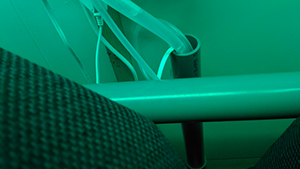
| Conduit carrying utilities down under the shroud of aquarium H. (The horizontal pipe passing in front of the conduit is draining Aquaria 1~20) |
Uses of Aquaria H & J: Light-Cycle Experiments
Currently, these aquaria are used to hold small experimental colonies of Hemigrapsus sp. These crabs are the subject of research aiming to manipulate crab egg production so that, ultimately, a controlled and reliable supply of crab zoea larvae can be made available as feed for Octopus sinensis paralarvae.
|
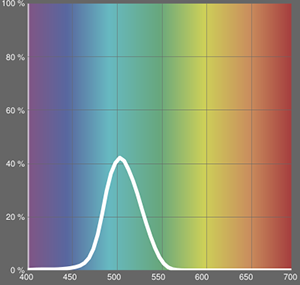
| Lee Filter no. 735 transmission spectrum (reproduced with permission) |
These two aquaria are part of a pilot experiment to test the effects of photoperiod on shorecrab egg production. Each aquarium is covered with a blackout shroud because they are held at different photoperiods: H is on long days (LD 14:10), and J is on short days (LD 10:14). A specially selected and tested LED light array suspended above each aquarium produces minimum heat (less than 40°C when covered), allowing the tanks to be safely covered with a blackout shroud without the risk of fire. (Normally it is not safe to cover LED lights as, like other light sources, they can produce dangerous amounts of heat).
To enable the aquaria to be shrouded effectively, the air and water supply to the aquarium and the electrical lead powering the LED light array are passed through a long, U-shaped conduit composed of three lengths of opaque VP-30 PVC pipe connected to three L-pieces. This conduit (designed by Moemi Kanno) passes away from the aquarium along the surface of the supporting table, allowing the shroud to be wrapped over it, minimizing light leakage (either in or out). The outflow drain from the aquaria passes from the base of each aquarium directly beneath the table and is also constructed from opaque PVC piping.
Ideally, these two aquaria should be housed in separate rooms, each set to a different LD cycle, but currently such facilities are not available so use is being made of blackout shrouds to run a series of pilot experiments. To facilitate three different photoperiods being tested at the same time, light intensity is reduced throughout (to reduce the impact of light possibly leaking from systems with lights on when lights are off in another system). The room housing the aquaria has a green filter (Lee filter no. 735) covering the fluorescent room lights, and the LED light arrays suspended above aquaria H and J are each covered with the same green filter as well as a neutral density filter (Lee no. 299). The light intensity at the water surface in aquaria H and J is 10.0~12.5 Lux. The shrouds are opened during the common daylight period, to feed the crabs and for aquarium cleaning and maintenance.
Since the green filter cuts out both red and blue light (see the illustrated spectrum), photosynthesis is not possible, so the aquarium circulation system is not fouled with algal growth. However, as they are omnivorous, the crabs receive feed supplemented with fresh or dried algae.
|
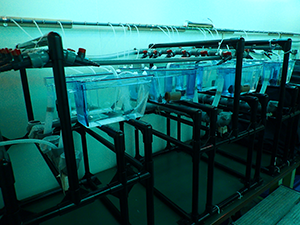
| Aquaria 1~20 |
Construction of Aquaria 1~20
A number (maximum 20) of small rectangular aquaria are mounted on a supporting framework of Creform steel piping (Erector Pipe, 28 mm diameter; Yazaki Kako, plc, Shizuoka). The aquaria are served by the lab. air system and the same water circuit as aquaria H and J. A sloping drain constructed of VP-40 PVC pieces and braided flexible hose drains back to the common sump unit (see above).
Use of Aquaria 1~20
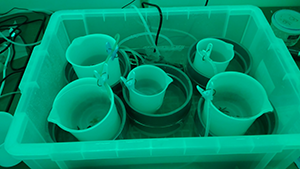
The small aquaria mounted on racks each house a male-female pair of crabs. They are fed daily and monitored for the presence of eggs. Once eggs are detected protruding from the abdomen of the female, she is removed to an individual container until larvae are released. The released larvae are allowed to flow out of the container, which is placed on the net bottom of a custom-built zoeae culturing unit. The female is then returned to the rest of the crab colony and the zoeae are raised to the required stage to provide feed for octopus paralarvae or juveniles.
|
| Crab larvae hatching and culture system |
Crab Larvae Culture Units
|
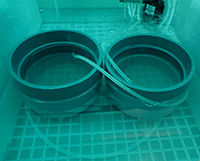
| Crab larvae culture units |
These units are each constructed from a section of grey VP-150 PVC pipe fitted into a shortened VP-150 socket and are placed inside a container of aerated artificial seawater with small pumps to circulate the seawater to each culture unit. A piece of 250 µm nylon mesh is jammed between each piece of pipe and socket, forming a raised base which allows the passage of water but retains the larvae. Water is pumped gently into the upper part, drains through the nylon netting and is recirculated after passing through gaps cut into the base of the VP-150 socket.
Just prior to egg laying, gravid females are transferred to a white polypropylene beaker into which seawater is pumped gently. The beaker is placed in its own culture unit and in the evening of hatching, the zoeae are carried out of the beaker by the water flow into the culture unit. The netting of the culture unit retains the larvae and once all hatchling zoeae have been released, the beaker with the spent female is gently removed, leaving the zoeae in the culture unit. Each female crab will produce eggs two or three times if cultured carefully and suitably fed.

